
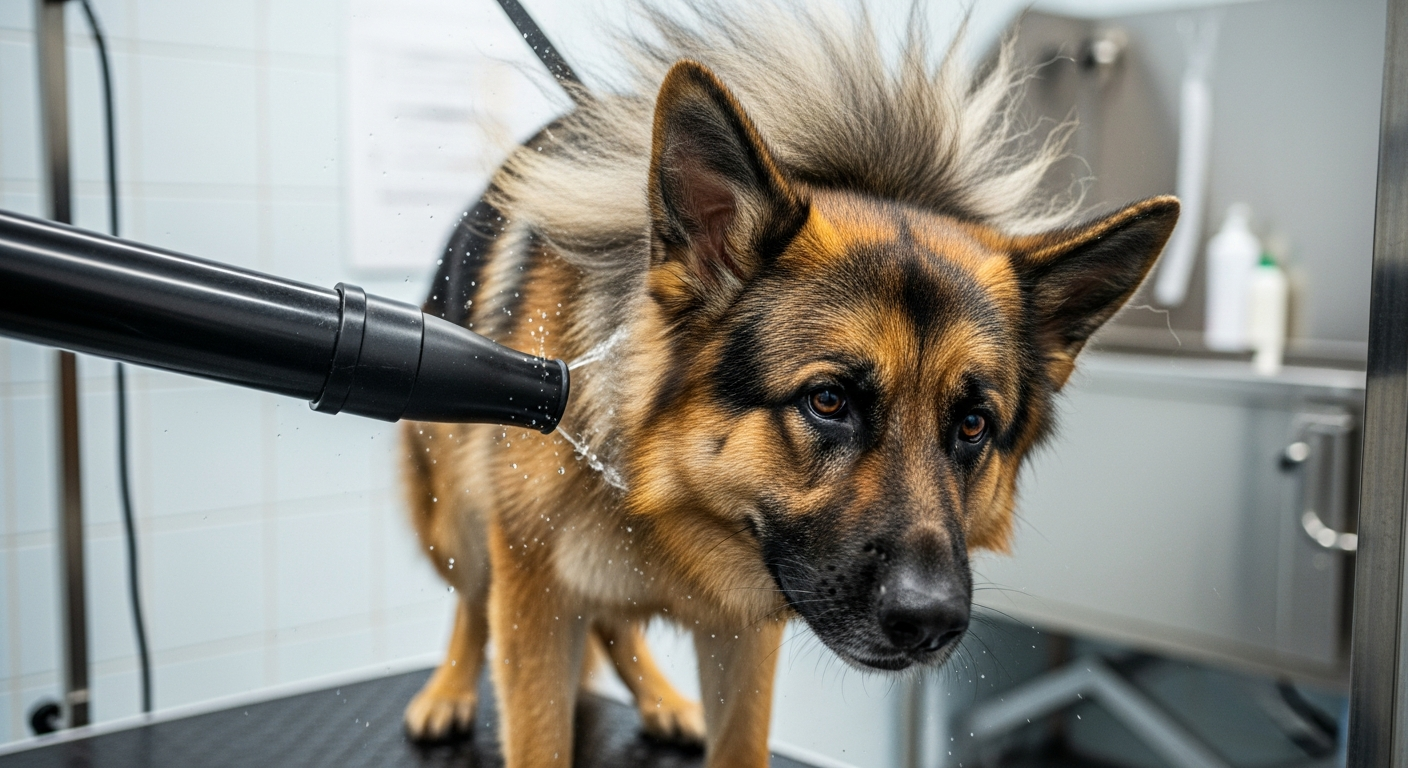
If you have ever watched a professional groomer blow-dry a Samoyed, you have seen what a high-velocity (HV) dryer can do. In the 15 minutes it takes to blow out a post-bath coat, they extract more loose undercoat than you would get from an hour of brushing. HV dryers have migrated from salon-only equipment into the home-groomer market over the past decade, and several solid models are now available for under $300. This guide covers how they work, what to look for in a home unit, how to use one safely, and the specific cases where a home HV dryer makes financial sense versus professional grooming.
What an HV Dryer Actually Does
A high-velocity dryer forces air at very high pressure through a narrow nozzle, creating enough velocity to physically push loose undercoat out of a double coat while water droplets are still being evaporated by the airflow. The key specification is not temperature (HV dryers operate with little or no heating element) but cubic feet per minute (CFM) of airflow and the nozzle velocity it produces. Professional-grade dryers deliver 250 to 350+ CFM at the nozzle with multiple speed settings. Home-grade dryers typically deliver 150 to 250 CFM.
The physical mechanism is what makes the HV dryer transformative for double-coated breeds. An ordinary household hair dryer relies on heat to evaporate water; the dog stands still and the coat dries slowly. The HV dryer, in contrast, blasts the water out of the coat mechanically and, crucially, also blasts out loose undercoat that brushing alone will not reach. For a coat-blowing Husky, Malamute, or Samoyed, the HV dryer is the most effective shedding tool in existence. Our spring shedding roadmap specifies where it fits in the seasonal workflow.
Key Features to Look For
CFM and Motor Size
For a single-dog home, 200 CFM is the practical minimum for a double-coated breed. Below that, you spend too long on each session and the extraction effect is less dramatic. 250 CFM is the sweet spot for home use: enough to extract undercoat effectively, without the noise level or power draw of a 300+ CFM salon unit. Units with dual motors (e.g., Flying Pig 3.0 HP) deliver more CFM but are louder and heavier.
Heat Setting
Most dedicated HV dryers have no heat element (the air is warmed slightly by motor inefficiency, but not actively heated). A subset offer a low heat setting for cool weather drying. Avoid heated HV dryers above 110 F at the nozzle; the combination of high velocity and heat can burn paws, ears, and eye tissue and makes the session more stressful for the dog.
Noise Level
HV dryers are loud. Salon-grade models measure 85 to 95 dB at operator position. Home models are closer to 75 to 85 dB. Noise-sensitive dogs need gradual desensitization before the first full session; startling a dog with an HV dryer on day one can create lasting fear that makes every subsequent session harder.
Hose Length and Nozzle Selection
A 9 to 10 foot hose allows you to move around the dog without dragging the motor. Most quality dryers come with 3 to 5 nozzle attachments: a wide nozzle for bulk drying, a narrow nozzle for precision work, and a small nozzle for faces and paws. The 90-degree elbow nozzle is particularly useful for working the underside of the dog without putting the motor directly in the way.
Recommended Models
For Most Home Groomers: B-Air Bear Power BP-2 ($229)
A dual-speed 2 HP dryer with 175 CFM, this is the model I recommend most often for owners of one or two double-coated dogs. It handles a Husky coat effectively in about 30 minutes post-bath, and the noise level is tolerable for noise-resilient dogs after a short desensitization period. Build quality is solid; I have one in my home setup that has performed daily for 4 years.
For Aggressive Shedders or Multi-Dog Homes: Flying Pig 3.0 HP ($280)
A higher-power dryer (around 220 CFM) that cuts drying time substantially. Louder than the B-Air, but worth the extra noise for owners dealing with thick coat breeds (Malamute, Great Pyrenees) or multiple dogs. The hose is 10 feet, long enough for large-dog work without repositioning.
Salon-Grade for Serious Home Operators: Double K Challenger ($550+)
If you groom multiple dogs professionally or semi-professionally from home, the Double K Challenger delivers 325 CFM and lasts for decades with basic motor maintenance. It is overkill for a single-dog household, but it is the tool you grow into if home grooming becomes part of your routine.
Safe Use: Technique Matters
HV dryers are effective but demand proper technique to use safely.
- Never point the nozzle directly at the eyes, ears, or anal area. The pressure can cause injury.
- Use ear covers or cotton in the outer ear canal to protect the dog's hearing from both airflow and motor noise.
- Start at the hindquarters and work forward; this is more tolerable for most dogs than starting at the head.
- Keep the nozzle 2 to 4 inches from the coat. Closer is not better.
- Move the nozzle continuously; do not hold it in one spot for more than 2 to 3 seconds.
- Combine dryer work with brushing; the HV dryer extracts undercoat that brushing alone cannot reach, but a slicker or undercoat rake between passes captures what the dryer has loosened.
- Monitor the dog continuously. Panting, pulling away, or escape attempts mean you should pause.
For a detailed session sequence that incorporates the HV dryer alongside brushing and combing, our grooming session guide walks through the full flow.
When a Home HV Dryer Makes Financial Sense
A professional deshedding bath-and-blow at a quality salon costs $80 to $150 per visit. During coat blow, most double-coated dogs benefit from a professional session every 2 to 3 weeks, which annualizes to $400 to $600 minimum for the two shedding seasons combined, plus occasional mid-season sessions. A $230 home HV dryer, amortized over 4 to 5 years, runs $50 per year. The math favors home ownership after the first season for owners of double-coated breeds. That said, professional groomers deliver more than just dryer time; they catch coat problems early and have experience your home setup will not match.
Desensitization for Dogs New to HV Dryers
Most dogs do not start out tolerating a loud dryer pointed at their flanks. A 3-week desensitization protocol builds tolerance:
- Week 1: turn the dryer on in the same room as the dog but not pointed at them; reward calm behavior. Move closer each day.
- Week 2: hold the dryer near the dog (1 to 2 feet away) without directing airflow at them; reward calm behavior and gradually move closer.
- Week 3: brief (5 to 10 second) airflow on the rear or flank at low speed; reward heavily; extend session duration gradually.
Dogs with severe noise sensitivity may need trainer support to build tolerance, and some may never fully accept HV dryers. For those dogs, continued professional grooming is the right choice rather than forcing acceptance.
Maintenance and Longevity
HV dryers last for years with minimal maintenance: clean the air filter monthly (more often during heavy shedding), store the unit in a dry environment, and check the hose for wear annually. Most failures I see are related to contaminated air filters that eventually burn out the motor. The cost of a replacement filter is under $20.
The ASPCA's grooming safety guidance is a useful general reference alongside the specific technique points above.
Bottom Line
A home HV dryer transforms double-coat grooming for owners willing to invest $200 to $300 and commit to learning correct technique. It dramatically reduces shedding season time, improves coat health, and saves money compared with recurring professional grooming over a dog's lifetime. Pair it with the tool selection in our grooming tools article and the seasonal plan in our spring shedding roadmap for a complete home grooming setup.