
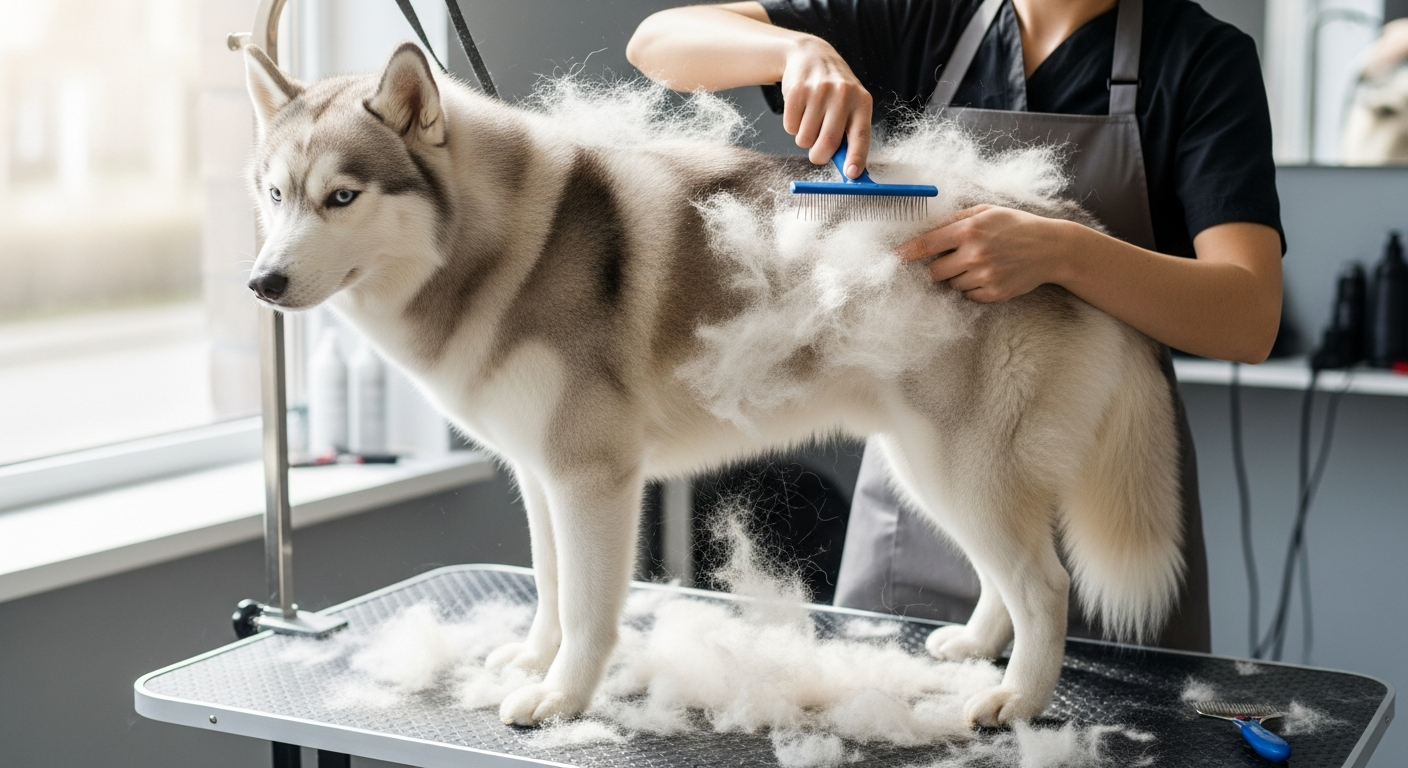
Every spring, around the time the daffodils come up, Winston starts losing his winter undercoat by the handful. If you have a double-coated breed, you know this particular moment well: clumps on the floor, a haze of fur on every fabric surface, and the gnawing sense that you should probably be doing something about it more proactively. This is my week-by-week roadmap for managing spring coat blow in a double-coated dog, built from a decade of running my own grooming practice and working on thousands of shedding sessions.
Why Spring Matters More Than Fall
Double-coated breeds typically experience two major shedding events per year: a spring shed, when the dense winter undercoat releases to prepare for warm weather, and a fall shed, when the lighter summer undercoat gives way to new winter insulation. The spring shed is usually the more intense of the two because the winter undercoat was denser to begin with. Depending on your breed, your geographic climate, and your dog's individual coat characteristics, spring coat blow can last anywhere from 2 to 8 weeks, with the peak 10 to 14 days producing truly startling quantities of undercoat.
The American Kennel Club's shedding guidance confirms that proactive brushing during this window both speeds the shed and protects the top coat; dogs whose owners skip this phase often develop mats that complicate the late-shed phase and sometimes require professional rescue.
Week 1-2: The Pre-Shed Window
When you start to see tufts of undercoat emerging at your dog's flanks or rear, you are in the pre-shed window. Do not wait for full coat blow to start; start your work here. Two grooming sessions this week of 20 to 30 minutes each with a metal undercoat rake (Chris Christensen Mark V or equivalent, covered in our grooming tools guide) will get out the first layer of loose undercoat before it has a chance to mat. Use long, pulling-through strokes in the direction the hair grows. Do not dig in with the rake tip; let the comb teeth do the work.
The early work also lets you identify any mats that formed over winter. Address them early: brush apart gently, or use a detangling spray and a greyhound comb, before the coat blow intensifies and makes the mat harder to resolve.
Week 3-4: Peak Shed
This is the peak. Expect three to four grooming sessions per week of 30 to 45 minutes each. The goal is to extract as much loose undercoat as possible before it falls onto your floors, furniture, or mats inside the top coat. Sessions should begin with an undercoat rake in the direction of hair growth, move to a slicker brush for surface work, and finish with a greyhound comb to catch any small knots.
If your dog tolerates it, a warm bath with deshedding shampoo mid-week during peak shed accelerates the process dramatically. The combination of water softening the hair follicles, conditioner reducing static, and a high-velocity dryer blowing out loose undercoat can remove in 45 minutes what would take hours of brushing alone. This is the single best week to invest in a professional groomer session if you have never used one.
Week 5-6: Late Shed
By now, the volume of undercoat coming out per session should be meaningfully reduced. Two sessions per week of 20 minutes each maintains progress without over-brushing the coat. The focus shifts from bulk removal to detail work: behind the ears, under the collar, around the britches and tail base. These are the zones where stubborn residual undercoat clings and, if left, becomes the seed of next month's mats.
Continue using the undercoat rake but with lighter pressure than during peak. At this phase, over-aggressive raking starts to pull guard hairs along with the remaining undercoat, which damages the coat you are trying to protect. Our dedicated article on coat blow season expands on how to recognize the transition and adjust tool pressure accordingly.
Week 7-8: Maintenance and Closure
The spring shed is essentially complete by this point for most double-coated breeds in most climates. Drop back to a weekly full-brush session of 20 to 25 minutes. This is your regular maintenance cadence for the summer months. The goal now is to keep the top coat aligned, prevent summer-onset mats, and set up the coat for healthy regrowth.
If at week 8 your dog is still shedding heavily, there are three possibilities: the breed runs a longer shed cycle than typical (common in Alaskan Malamutes, Great Pyrenees, and a few other cold-climate breeds), the coat had accumulated matting that trapped undercoat and is only now releasing it, or there is an underlying health issue (hypothyroidism, nutrition deficiency, skin condition). If none of the first two apply, a veterinary visit is worth scheduling.
Tool Checklist for the Season
- Metal undercoat rake (Chris Christensen Mark V or Safari equivalent)
- Firm slicker brush (Chris Christensen Big G or Big K)
- Stainless steel greyhound comb
- Deshedding shampoo and conditioner
- Optional but highly recommended: high-velocity pet dryer (see our HV dryer guide)
- Detangling spray for minor knot work
- Grooming table or non-slip mat for safe session positioning
What to Skip
Avoid the Furminator during spring shed. Even used briefly during this high-volume window, the blade-style mechanism cuts top coat, and the damage shows clearly in coat condition 3 to 6 months later. Our article on why you should never shave a double coat covers the related harm-reduction logic. Avoid over-bathing; more than one bath per week during coat blow is drying and can worsen skin health. Avoid human shampoo; the pH is wrong for dog skin and will exacerbate any irritation caused by active shedding.
Special Cases
Senior Dogs
Senior dogs often have thinner skin, reduced tolerance for long grooming sessions, and arthritis that makes extended standing uncomfortable. Shorten sessions to 15 minutes and use a padded grooming surface. Multiple short sessions can replace a single long one. Our grooming session guide covers positioning and pacing for older patients.
Anxious Dogs
Dogs who find grooming stressful respond well to short, predictable sessions paired with high-value food reward. Ending the session while the dog is still calm (not after they have tried to escape) is critical. For severely anxious dogs, a combination of desensitization work with a trainer and professional groomers experienced with fearful dogs is the right long-term path.
A Note on Environment
Double-coat sheds produce enormous quantities of loose fur. Working outdoors, in a garage, or on a grooming table is far easier to clean up than working on your living room floor. A quality shop vac with a HEPA filter handles the volume better than a household vacuum, which typically clogs quickly. Many groomers (including me) keep a lint roller on a stick in the grooming room because it is the single most efficient tool for picking up the fine surface layer that settles on every surface within 20 feet of the session.
Bottom Line
Spring shed is not something to endure; it is something to manage. A structured week-by-week plan prevents the worst outcomes (matting, coat damage, frustrated owners giving up) and delivers a noticeably healthier coat by summer. Eight weeks of consistent work replaces what would otherwise be 4 months of sporadic panicked brushing with poorer results. For the related tool selection details, our grooming tools article pairs directly with this roadmap.